
How do you clean a menstrual cup in public?
an honest guide to public bathrooms:
water bottles, toilet roll, and what actually makes it easier.
If you use a menstrual cup, or you’re thinking about trying one, there’s one question that comes up again and again:
How do you clean a menstrual cup in public?
And the honest answer is… a lot of people are just winging it.
Some people empty it and reinsert. Some wipe it with toilet paper. Some bring a bottle of water into the cubicle. Some look for a disabled loo or a family bathroom with a sink. Some wear backup period underwear. Some switch back to pads or tampons for the day because they just cannot be bothered with the stress.
None of that is weird. It is just the reality.
Menstrual cups can be brilliant, but cleaning a menstrual cup when you’re not at home is still one of the biggest things that puts people off, or makes reusable period care feel like something that only really works in theory. So let’s talk about it properly.
We’ve spent a long time researching menstrual cups, and beyond face-to-face conversations, Reddit has genuinely been a goldmine, especially the r/menstrualcups forum. It is full of lived experience, practical advice, and honest conversations about what cup use actually looks like in real life.
That said, while the forum is moderated, misinformation can still appear, so for anything medical, it is always worth checking trusted sources like the NHS as well.
And while we are a business, we are never going to pretend Halo is the only option or gatekeep the other ways people make cup use work. So here’s our honest take on cleaning a menstrual cup in public, the workarounds people rely on, and why they shouldn’t have to be the standard.
Do you always need to clean a menstrual cup in public?
Not always. For some people, the easiest answer is simply timing. They empty their cup before leaving the house, then deal with it later when they get home.
One person wrote:
“I can leave the cup in for 8 hours normally so I can go out and not need to change it until I get home.”
Another said:
“I can get 10-12 hours out of mine. The idea of public toilet germs scares me.”
And honestly, fair. If that works for you, great. But it does not work for everyone. Heavy days exist. Long shifts exist. Travel exists. Delays exist. Shared bathrooms exist. Real life is not always neat.
One reply summed that up perfectly:
“Good golly I’m jealous of yall 😭 My periods get so bad that I fill the cup every hour on my worst days.”
So yes, sometimes you can wait. Sometimes you really cannot.
What do people actually do when they need to empty a menstrual cup in public?
This is where things get very honest, very quickly. Because there is usually no sink in the cubicle, and very few proper portable rinsing options, a lot of people skip the rinse altogether and go straight from emptying to reinserting. It is probably the most common workaround.
The routine is usually simple: remove the cup, empty it into the toilet, put it back in, then wash your hands properly afterwards.
One Reddit user put it simply:
“I pull it out, dump it, pop it back in, clean up with toilet paper, leave, wash hands as normal.”
Another said:
“I dump and reinsert. I don’t bother wiping it because most office toilet paper is awful and just sheds on the cup.”
This is clearly normal. People do it all the time. The standard advice is to rinse your menstrual cup with water before reinserting it, as that is generally the most hygienic option, but we completely understand that with the current public bathroom setup, that is not always realistic.
And that says a lot. One of the most common approaches is basically: do your best, be quick, and move on.
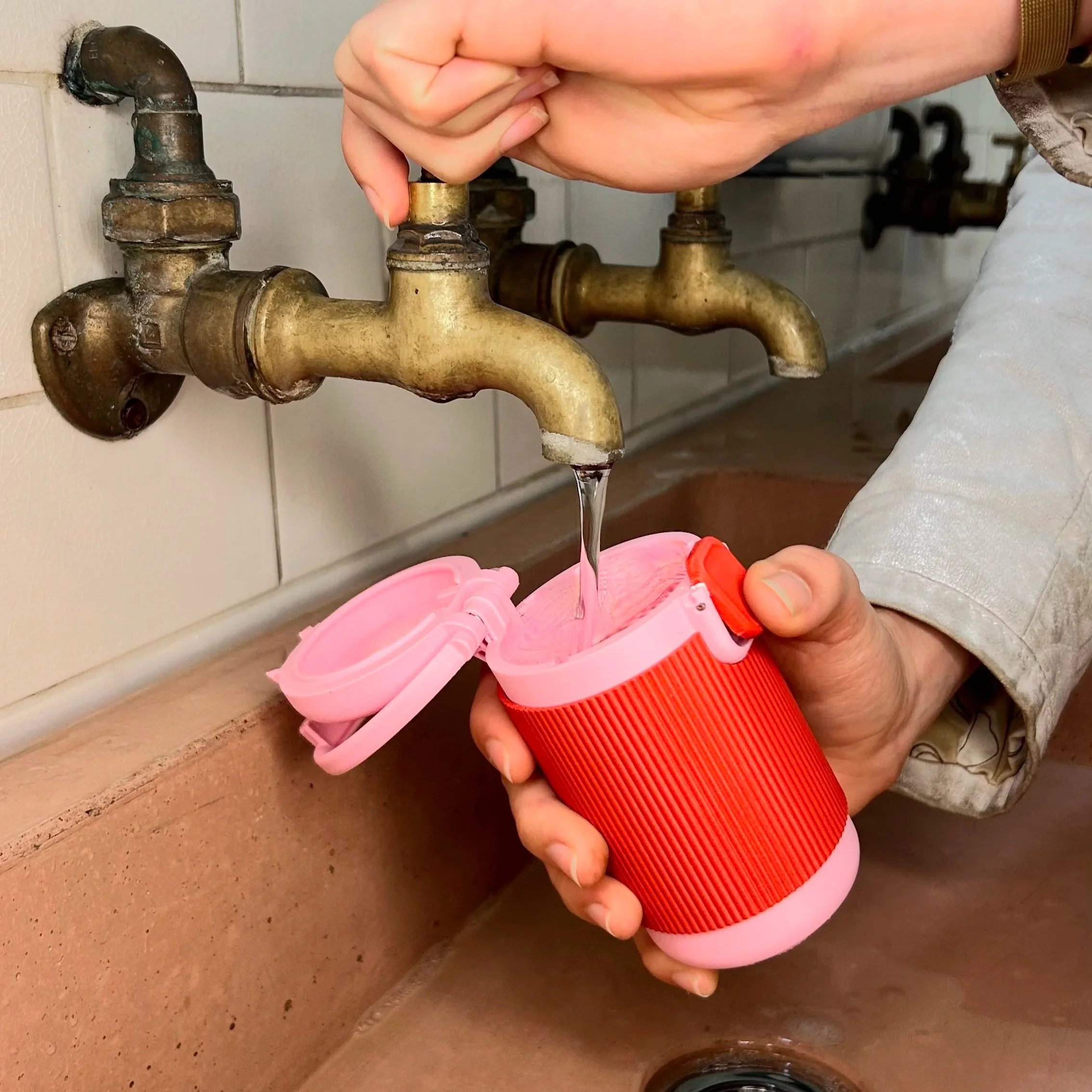
At Amora, we are not huge fans of people being told to simply deal with it. Period care should not have to feel like a compromise between hygiene, comfort, and convenience. That is why we designed Halo: a portable menstrual cup rinsing pod made to support real life, not just the ideal scenario.
Is it okay to wipe a menstrual cup with toilet paper?
A lot of people do.
It is accessible. It is there. It feels better than nothing. But it is also one of those solutions that sounds less than ideal the minute you say it out loud.
One person said:
“You could bring a squirty water bottle in the stall as well if you wanted but wiping out is fine.”
That word, fine, says a lot. Not easy, or clean, or comfortable.Just fine.
Another user said:
“Honestly I think it’s fine to dump the blood in the toilet when you are in a public restroom, wipe it lightly with TP (don’t leave paper residue behind), and put it back in for a few hours until you get home and can clean it the way you desire.”
Again, practical, realistic- but still very much a workaround.
How do people rinse a menstrual cup in a public bathroom stall?
Usually with a bottle of water.
One person wrote:
“I usually took a bottle of water or a disposable cup or two into the stall with me to clean up.”
Another said:
“If I’m feeling fancy I’ll bring a water bottle and a little hand towel into the stall.”
Then there’s this one:
“I have a lil collapsible silicone cup that I fill before I go in the stall, and rinse it out in there. works out OK.”
These are clever, resourceful fixes. They also make it very clear how much effort users are expected to put in just to make menstrual cups work away from home.
Water bottle through the legs. Balancing cup, bottle, clothes, toilet paper, and your own dignity in a cubicle. It works, technically. But it is not exactly the kind of seamless experience most people imagine when they hear the word convenience.
Why does using a menstrual cup in public still feel awkward?
Because most public bathrooms were not designed with this in mind. The issue is not just rinsing. It is privacy.
Hygiene. Space. Timing. Doors. Locks. Sink access. It’s like a short story of discomfort and irritation.
Whether someone is waiting outside. Whether you feel rushed. Whether you are having a heavy day. Whether the whole thing just feels like too much.
One of the most telling comments we found on Reddit was this:
“Honestly I have a different issue. Maybe it’s just in my head and science isn’t behind it but I don’t find emptying the cup in public hygienic if the sink isn’t in the stall.”
That is such a real, everyday thought process. It is not dramatic. It is not silly. It is exactly the kind of friction that makes a product feel doable in theory and stressful in practice.
Another person wrote:
“Wth guys 😭 I dump in the toilet and then go to the sink to wash it, return to the stall and insert. It can be awkward but I learn to be sneaky”
And the reply under that says:
“Same! I figure I’m in the GD women’s bathroom. I deserve to be able to rinse a menstrual cup in the sink without feeling embarrassed.”
That really is the tension, isn’t it? People are doing something completely normal, but still feeling awkward, exposed, or like they have to be discreet about it.
Now, let’s make one thing clear. At Amora, we are loud and proud about periods. There’s no need to hide things up sleeves or use euphemisms for our bodies or periods. I mean, thats why we are called Amora, it’s all about love for our bodies. However, we are never going to tell you to simply, “get over it”. Rinsing your period blood in front of others isn’t for the majority, and thats okay.
What if public bathrooms make you want to avoid using your cup altogether?
That is common too. Some people genuinely like their cup, but still change their behaviour depending on where they are and how long they’ll be out.
One comment put it very clearly:
“If I plan to be out longer, then I would opt for another method like tampons or pads because like you say, washing it properly in public bathrooms is not always possible.”
That matters. Because when people stop using their cup for the day, or avoid it at work, or switch back to disposables on heavier days, that is not a sign they have failed. It is a sign the current experience still is not good enough.
In an ideal world tampons and pads would be a thing of the past, not just for the environment, but especially for women’s health and wallets. Reusable period care gets talked about as though it is just a mindset shift and total change. But often it is a logistics problem, one which inhibits that total shift.
Do people just make it work anyway?
Yes. Constantly.
That is the thing. People are incredibly adaptable. They find systems, create routines, find compromises. They carry backup options, and put up with things that are awkward because there is no better option in the moment.
One person said:
“If [the water in my cup] was enough, I did everything in the stall. If it wasn’t, I’d leave the stall, refill my bottle or cup, clean the cup properly in sink then go back to my stall.”
Another said:
“I usually took a bottle of water or a disposable cup or two into the stall with me to clean up. If the water was enough, I did everything in the stall. If it wasn’t, I’d leave the stall, refill my bottle or cup, clean the cup properly in sink then go back to my stall.”
That is kind of the whole problem. A lot of menstrual cup advice in public bathrooms boils down to: awkward, but manageable. That should not be the standard, let alone the gold standard.
So what is the best way to clean a menstrual cup when you’re not at home?
The most honest answer is this: There is no single perfect method that everyone uses.
Empty and reinsert.
Wipe with toilet paper.
Bring bottles of water.
Use collapsible cups.
Wait until you get home.
Switch products for the day.
Wear backup protection.
Avoid the whole situation when they can.
All of those things are happening every day. And yes, they are valid. But they are also a pretty clear sign that this category has been asking users to do too much for too long.
Because really, how to clean a menstrual cup when you’re not at home should not feel like a niche life hack thread. It should feel straightforward.
Where does Halo come in?
Halo is not here to pretend the other options do not exist.
They do. People use them. People make them work. That is exactly why this conversation matters.
But Amora is here to say those workarounds should not have to be the standard.
Not the water bottle gymnastics.
Not the toilet paper compromise.
Not the “I’ll switch back to pads today”.
Not the constant planning around when and where you might need to empty your cup.
Halo exists for the person who is tired of making do. The person who likes the idea of reusable period care, but knows the public bathroom part still feels like the catch.
The person who wants a menstrual cup routine that works in real life, not just in the comfort of their own bathroom.
If you are that person, check out Halo.
Final thought
If you have ever searched how to clean a menstrual cup in public, the truth is that most people are piecing together whatever works in the moment.
That does not mean those solutions are ideal. It just means they are what people have had.
And that is exactly why we wanted to write this. Not to act like there is one perfect answer. Not to shame anyone for using wipes, toilet paper, a bottle of water, or whatever else gets them through the day. But to say out loud that these are workarounds, not gold-standard experiences.
Reusable period care should not feel easy only when you are at home.
And if you are tired of “fine”, “awkward but manageable”, or “I’ve learned to be sneaky”, you are exactly the reason Amora exists.
References
https://www.reddit.com/r/menstrualcups/
https://www.reddit.com/r/menstrualcups/comments/1df8q10/how_do_you_wear_menstrual_cup_in_public/
https://www.nhs.uk/conditions/periods/
https://www.gosh.nhs.uk/conditions-and-treatments/general-health-advice/period-products/
